
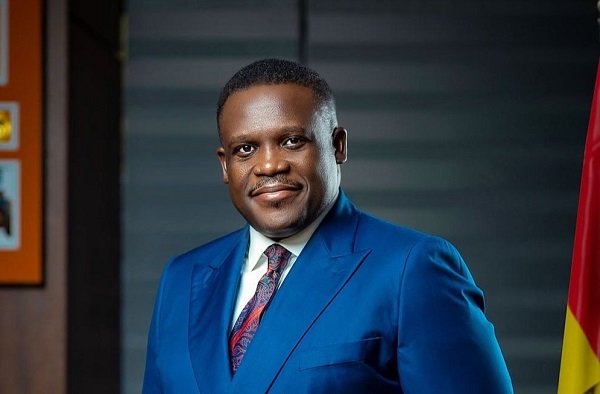
Ghana’s Minister for Communication, Digital Technology, and Innovation, Samuel Nartey George, has raised alarm over the future of global order and respect for state sovereignty following the reported arrest of Venezuelan President Nicolás Maduro by United States forces. He warned that the incident risks repeating the destabilizing patterns seen in past Western-led interventions in Libya and Iraq.
The concerns follow reports that, in the early hours of January 3, 2026, U.S. troops carried out a coordinated operation in Caracas that resulted in the detention of Maduro and his wife, Cilia Flores. The operation has reverberated across diplomatic and security circles, prompting intense debate over its legality and broader implications.
In a post on his X account the same day, George drew on his academic training in peace and security to contextualize the unfolding developments. A graduate of the Kofi Annan International Peacekeeping Training Centre, he described the incident as a live demonstration of international law theories he once studied.
He wrote that the events in Venezuela had revived questions surrounding territorial integrity, the conditions under which the Responsibility to Protect doctrine is invoked, and the role of powerful states in intervening beyond their borders. According to the minister, these issues are central to understanding whether the Caracas operation fits within accepted international legal norms.
George went on to question whether Latin America could now face a trajectory similar to that experienced by Libya or Iraq. He also challenged observers to examine how the U.S. action compares with Russia’s conduct in Ukraine or Israel’s military operations in Palestine, suggesting that inconsistencies in enforcement of international law remain deeply problematic. He characterized the moment as a defining one for global affairs and legal norms.
His remarks echoed Ghana’s official diplomatic stance. On January 4, 2026, the Ministry of Foreign Affairs issued a strongly worded statement condemning what it described as an unauthorized and unilateral incursion into Venezuelan territory. The government expressed deep concern over the early-morning seizure of the Venezuelan president and his spouse.
The statement reaffirmed Ghana’s opposition to the use of force outside multilateral frameworks, emphasizing that such actions contravene the United Nations Charter and erode the sovereignty and political independence of states. It cautioned that military interventions framed as regime change carry severe risks for international peace and stability.
Accra also voiced unease over remarks attributed to U.S. President Donald Trump indicating that Washington would temporarily administer Venezuela and involve major American oil companies in managing the country’s resources. Ghana warned that such rhetoric evoked colonial-era practices and could legitimize a dangerous precedent in international relations.
George’s reference to Libya recalled the 2011 NATO campaign that led to the overthrow of Muammar Gaddafi. Although that intervention was initially defended as a civilian protection effort, it ultimately resulted in regime change and left Libya fractured and unstable for more than a decade. The Iraq parallel points to the 2003 invasion justified by now-discredited claims about weapons of mass destruction, an intervention that plunged the region into prolonged violence and instability.
The minister’s academic background adds weight to his critique. His research focused on the legal and ethical boundaries of international intervention, particularly the circumstances under which sovereignty may be overridden. The Responsibility to Protect principle, developed after the atrocities in Rwanda and the Balkans, was meant to prevent mass crimes but has remained controversial when used to justify military action leading to regime collapse.
According to statements from Washington, the operation involved a pre-dawn raid on Maduro’s residence, supported by strikes on strategic military targets in Caracas. President Trump announced that Maduro had been transferred to the USS Iwo Jima and was en route to New York to face charges including narcoterrorism and drug trafficking conspiracy. U.S. Attorney General Pam Bondi confirmed the indictments, asserting that the couple would be prosecuted under American law.
Trump further stated that the United States would oversee Venezuela’s transition, though no clear timetable was provided. The move marks the most significant U.S. military intervention in Latin America since the 1989 removal of Panama’s Manuel Noriega, an episode that also sparked enduring legal and political controversy.
Within Venezuela, Vice President Delcy Rodríguez was instructed by a local court to assume interim leadership duties. However, the United States has signaled reluctance to recognize any successor arrangement linked to Maduro’s administration. The situation has opened complex debates around legitimacy, intervention, and the enforcement of international law.
International responses have been sharply divided. Russia and China denounced the operation as illegal, while Brazil’s president described it as a return to the darkest periods of external interference in the region. Several Latin American governments, including Colombia, Mexico, and Chile, issued strong condemnations. In contrast, leaders in Argentina and El Salvador welcomed the move, while the British prime minister noted satisfaction at the end of Maduro’s rule but stressed the importance of legal norms.
The United Nations Security Council has scheduled an emergency meeting to address the crisis, with the Secretary-General warning that the action could undermine the international legal order.
George’s intervention reflects broader anxieties among African policymakers and scholars about the gradual erosion of rules-based global governance. Many fear that unilateral actions by powerful states weaken the post–Second World War international system.
By questioning how Venezuela is judged relative to Ukraine or Palestine, the minister highlighted longstanding accusations of selective application of international law. While Venezuela’s political isolation, disputed elections, and humanitarian crisis set it apart from past cases, similarities remain in the absence of UN authorization and the uncertainty surrounding post-intervention governance.
Supporters of the operation argue that it ends an entrenched authoritarian regime, while critics contend it represents a critical stress test for the principles of sovereignty and non-interference. Ghana’s response—both at the governmental level and through George’s public commentary—reinforces its longstanding foreign policy posture favoring multilateralism, restraint, and respect for international law.